3.22.2008

Salmon found at Pringle Creek Community

Karen Hans, a biologist from the Oregon Department of Fish and Wildlife, came out to Pringle Creek Community last week. She brought a group of 8th graders from the Jane Goodall Environmental Middle School. They came out to do a fish count in Pringle Creek.

They found a 5-inch Coho salmon; a 10-inch Cutthroat trout; and a 1-inch trout fry (which was probably also a Cutthroat). The significance of finding the Coho is that it shows there is a certain degree of fish passage between Pringle Creek Community and the Willamette River. The significance of the 1-incher is that it shows that fish are spawning here.

This is very exciting news because it demonstrates how collaborative creek restoration in an urban setting can have a measurable positive impact on fish and wildlife. If we protect the riparian zone and make it more habitable, the fish will return.

-- santiago

3.11.2008

Pringle Creek Team: James Meyer

It’s an oldie but goodie, a December 2005 interview with Pringle Creek masterplanner James Meyer that was originally in the Journal of Daily Commerce. Now it is on the allbusiness dot com website. To read the entire article you’ll need to register.

Pringle Creek comes up a few times. The interview focuses on James and his partners getting Opsis Architecture off the ground and thriving in the fast-paced Portland market.

DJC: Is there an overarching philosophy behind the firm's work?

James Meyer: I think it's fairly soft, or loose. It's not a philosophy so much as a foundation of values. The environmental values are imbibed very strongly. All the partners are (University of Oregon) graduates who graduated together, did studio together, so we've got this history. And I think that the U of O during those times really reinforced that part of making buildings with sensitivity to the environment that would manifest itself in ways of daylighting, energy efficiency, site orientation.

These are all components that (University of Oregon professors and sustainability advocates) Charlie Brown and John Reynolds were talking about a long time ago, before there was a U.S. Green Building Council, before there was LEED (the USGBC's rating system for green and sustainable buildings), before all this stuff.

I did my first solar house in '73 or '74. I think with us, and especially the partners here, that's been this foundation that a lot of the other components built upon.

And then from that, it's design excellence, it's spaces that are humanistic, it's a listening philosophy. We just listen, to the clients and the process focus and development, those kinds of things.

Below is a photo of James (center, leaning) and his partners from a 2006 Portland Tribune article about the green renovation of their building.

3.04.2008

Think tank says Pringle Creek "may be" greenest

The Center for American Progress (CAP) is a large and influential progressive think tank headed by former Clinton Chief of Staff John Podesta. CAP has a new weekly website series to recognize “those who are taking action to address climate change and help create a low-carbon economy.” The series is called “It’s Easy Being Green” and last week’s article is titled “Is Pringle Creek the Greenest Neighborhood?”

Pringle Creek Community in Salem, Oregon, named the 2007 Green Land Development of the Year by the National Association of Home Builders, may be the greenest neighborhood in the country. And what’s more, Don Myers, president of the community’s developer, says, “It’s clean, it’s nice, it’s elegant, it’s all the things that I think are what a lot of people in residential architecture are comfortable with.”

Sure, it would have been nice if CAP would have said "yes, Pringle Creek is the greenest." But it’s quite exciting to get national exposure as the neighborhood that “may be” the greenest.

2.28.2008

Silver Award for Cottage Home!

This is more recognition that Pringle Creek's Cottage Home #1 is no ordinary house. The NAHB Research Center gave it a silver Energy Value Housing Award. The award ceremony was February 13 at the 2008 International Builders’ Show in Orlando, Florida. It's a huge trade show, with attendance of over 90,000. Pringle Creek’s Don Myers attended.

Cottage Home #1 was a finalist in the “production” category in the “moderate” climate region. It is the first house built at Pringle Creek.
It was built by Salem homebuilders Larry and Blake Bilyeu and designed by Opsis Architecture of Portland. It features advanced framing techniques (including a “rain-screen” siding), a 2.5 kilowatt photo-voltaic system, passive solar design, geo-thermal heating and rainwater harvesting. All of the lumber used was from sustainable forests. The home is estimated to consume 70% less energy than a conventional home of the same size. In July 2007, the home received LEED-Platinum certification, the highest level in the Leadership in Energy and Environmental Design program. It was the first LEED-Platinum home in the northwest, just the sixth nationally.

We wrote about being an EVHA finalist here and provided more extensive info about the house here.

2.12.2008

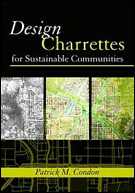
Patrick Condon's new book


Patrick Condon is a member of the Pringle Creek planning team. His most recent book, "Design Charrettes for Sustainable Communities" is on this year's Planetizen Top 10 best books in the planning field. Congratulations Patrick. Here is what Planetizen says about it:

The design charrette has gained popularity and notoriety among many communities as a powerful tool for public participation in recent years, and this book provides a step-by-step manual to harness this power. Drawing on Condon’s years of experience shaping and honing the charrette process, this book is a straightforward guide that lays out the essential steps and best practices for running a productive design charrette. His advice is equally applicable to public officials, developers and the general public – offering an insider’s view into the somewhat complicated process of pushing plans forward with both transparency and an ear to the public voice.


Patrick Condon is James Taylor Chair in Landscape and Liveable Environments at the University of British Columbia. He is a leading advocate of sustainable development with focus on the nexus of environmental design and creating a strong sense of community. He has served as friend and creative advisor to Sustainable Fairview and Pringle Creek Community.

More Patrick Condon info:
His biographical info page at UBC
Streaming audio of a two-hour talk "Green Urban Infrastructure for the 21st Century (Feb. '06)

2.06.2008

On the roads again

Pringle Creek’s porous asphalt roads are all over the media these days--and for good reason. Take a look at this dramatic photograph showing the Pringle Creek entrance, where the beautiful porous pavement meets the flooded impervious city street.


Click here to see more such photos (thanks, santiago). Clearly, "pervious" is better. No wonder these streets are getting so much media coverage. The latest is Porous Streets Work--Even in Rainy Oregon on the worldchanging website. Columnist Erica Barnett expresses disappointment that supposedly "green" Seattle recently repaved a parking lot near Lake Washington with impervious asphalt:

What reminded me of that incident was a story in the Salem, Oregon Statesman Journal about a system of porous streets in that city's Pringle Creek Community, a housing development that has gotten national praise (even landing on Natural Home's list of the top 10 "green" housing developments in the US) for its green building and sustainable-design practices. Community members had worried that the system would not be able to stand up to Oregon's wet winters; so far, with February getting underway, residents have been hard-pressed to so much as find a puddle.

The two hyperlinks are in the original. The referenced Statesman Journal article is new, so take a look at that. And here is yet another, the website of Construction Equipment Guide. It is featuring Willamette Valley Tabbed for Porous Asphalt Streets, a very technically informative piece. Here's a sample:

The contractor washed and vacuumed the fines out of the pavement before laying the final lift of 2-in. (5 cm) pervious wearing course with a 3/8-in. (0.95 cm) top-size aggregate. The wearing course utilized a polymer modified PG 70-22 grade binder to reduce drain down and enhance long-term durability. The surface course was laid from May 25 to June 2. River Bend Sand and Gravel produced the porous asphalt mix.

“This was a unique and challenging project,” said Ron Boschler, president of North Santiam Paving. “We had done a lot of projects using open-graded design, but nothing where the water is supposed to drain through the entire street, like this porous pavement. The pavement held up well under the construction traffic. The paving part of the job was very similar to an ordinary paving job.”

2.02.2008

Portland's new "guide for creating spaces to love"

The magnificent City of Portland. It prospers--and much of its growth is “smart.” People continue to move closer to the vibrant built-up downtown. Portland is known far and wide for good planning, green planning. Of course Portland would get a new magazine about:

. . . designing the places where we live, work, play and socialize. It’s a guide for creating spaces to love, from gardens, kitchens and living rooms, to workplaces and neighborhoods, to the city and the region as a whole. It’s about the opportunities and trade-offs in balancing sustainability, elegance and value, both when money is no object and also when it is, by necessity or by choice.

The premiere issue of Portland Spaces hit the newsstands a couple weeks ago. The feature item is a three-part Houses That Make History.

  • Part one, “three great expressions of today’s home design.”
  • Part two, a “timeline of the 164-year history of the single-family home in Portland” on their website here.
  • Part three, “building the future.” Portland Spaces found the future in Salem, at Pringle Creek Community:

. . . So the Wilsons began researching places where they could settle into their next phase of life. The Pearl District? South Waterfront? Bend? Nothing seemed to fit, until friends told them about one of the greenest new communities being built in the United States: Pringle Creek. And it happened to be only four miles from their home.

It may be surprising that the bar for American sustainability is being hoisted so high in a city the size of Salem, never mind the exact location: the former Fairview Training Center for the developmentally disabled. After the center was decommissioned in 2000, its 275-acre campus became an eco-cause célèbre for the Salem community. The result: one of the most environmentally advanced master plans ever adopted by a city. Pringle Creek will carry out 32 acres of that vision.

. . .

Call it the party at Pringle Creek: A sense of belonging has taken root even before the homes arrived. “I don’t think community is a stagnant thing,” Sue says. “We’ll learn from every participant and every project.”

We at this blog page have introduced the Wilsons, here.
But you would learn more if you could read the whole article, which isn't available on the internet. So consider subscribing to this cool new magazine. Meanwhile, take a look at the two Portland Spaces blogs, and in particular this blog item about buildings planned for Portland.

Photo above: Spaces editor-in-chief, Randy Gragg, unveils the magazine’s premiere cover.

1.24.2008

Your vote counts

This is not about the presidential primaries, it's about Pringle Creek’s Cottage Home being up for the People’s Choice Award at the Energy Value Housing Awards. Anyone can vote--once. You have until February 12. To learn more about the EVHA, see our earlier blog item. To visit the web page where you can vote, click here.

1.22.2008

A favorite journalist

I’m a big fan of journalist Neal Peirce. He received the Distinguished Urban Journalism Award from the National Urban Coalition for his outstanding contribution to the cause of America's cities. His columns are syndicated to over 50 newspapers, so he has considerable influence. Peirce tries "to report the best--and worst--of what's happening in our states and communities, to cross-fertilize ideas, to show the amazing new forces at work at the local level, even as the federal government retrenches.” Here is an index page for his columns going back six years. Below is from a recent column:

An open letter to the Democratic and Republican presidential candidates:

When will you finally start talking about the issues that matter specifically to cities and metro areas that are home territory to 80 percent of America's people?

. . .

Climate's a mega-issue, finally getting a smidgen of White House interest. But real cuts in greenhouse gas emissions will have to be focused at the metropolitan level where most energy is burned. More than 500 city leaders have signed the Mayors Climate Protection Agreement initiated by Seattle Mayor Greg Nickels.

But individual cities' climate efforts won't make much difference if neighboring jurisdictions just shrug their shoulders. Please, candidates, tell us how federal carrots and sticks could get all our localities working together for greenhouse gas reductions that really matter.

Week after week Mr. Peirce writes about issues that are central to fixing our cities. Here is from another recent column, on the complete streets movement:

Project for Public Spaces has some of the right advice for cities: “Stop planning for speed.” “Right-size” road projects in cities and suburbs to “reconnect communities to their neighbors, a waterfront or park.” And “think of transportation as public space” -- roads, transit terminals, sidewalks, reconfigured to create pleasant environments, a true sense of place.

1.07.2008

American Institute of Architects looks at Pringle Creek

The American Institute of Architects (AIA) is an organization of "over 80,000 licensed architects, emerging professionals, and allied partners." They call themselves the voice of the architecture profession. AIA wanted to know how the sustainable parts of Pringle Creek (i.e. the LEED-Platinum Cottage) fit into the whole sustainable project. They spoke with Pringle Creek masterplanner James Meyer and here is their web article.

Opsis is designing several other housing models (row houses, loft apartments, single-family homes, etc.), some as traditional as the cottage house, and others featuring more contemporary flat roofs and vertical profiles. They are currently building their first three-story “Tall House,” and other designs are in various stages of construction design and permitting.

These designs will be suggested templates for builders. Other architects are allowed to create new designs pending approval of the Pringle Creek Design Review Committee. However, the development’s commitment to sustainability is contractually mandated: All new buildings must be LEED certified. Meyer says the Design Review Committee’s charter is less aesthetically fixated and more sustainably oriented than a typical subdivision’s equivalent. “We’re not stylistically driving it, but we’re driving it on a set of principles,” he says.

Key to the development’s potential attractiveness, Meyer says, is allowing the community to grow and develop organically, without restrictive and detailed building regulations, so “that you feel there is a history of [the place], that it wasn’t just sort of a piece of machinery that was crafted the week before,” even though his initial design impulse might be to rigorously define this very machine.