7.17.2012

Gardens and Orchard in July

The gardens and orchards are full of life now that summer has arrived. All of the vegetable starts were started in the greenhouse from seed and have been moved outside to the main garden. The harvest of these plants will be turned into delicious menu items at Painter's Hall cafe.

Swiss chard, summer squash, carrots, tomatoes and basil growing in the greenhouse and garden space.

We are growing 2 types of artichokes, Green Globe and Imperial Star. Unfortunately the gophers enjoy them also.

The trees in the orchards are covered in developing fruit. The cherry trees have finished for the year but the rest of the trees will be producing into the fall season.


Plums, pears, apples, and peach trees produce fruit for Pringle Creek Community residents and Painter's Hall cafe.

The lavender is in full bloom and the honeybees from our hives along with the native bumblebees are frequent visitors. More flowers and spearmint brighten the garden space.


Flowers in the Pringle Creek Community garden.
The upcoming months will be filled with ripening fruit and growing vegetables. Stop by to enjoy the sights and tastes from the Pringle Creek Community gardens and orchard.

7.15.2012

Volunteers at Pringle Creek

Throughout the year, Pringle Creek Community provides many opportunities for volunteers to get their hands dirty.  Volunteers help with restoration of Pringle Creek and wetlands, beautification and upkeep of 12 acres of natural spaces, and seasonal projects in the Pringle Creek Community gardens and orchard.

In the past 6 months we have had 150+ volunteer service hours from:
  • Tokyo International University of America (TIUA)
  • Introductory Environmental Science class at Willamette University
  • Urban Farmer Certification participants
  • Neighbors of Pringle Creek Community
 THANK YOU to all our volunteers!

TIUA students weeding community plots in the garden.

TIUA students clearing out Japanese knotweed.

 Pringle Creek Community volunteers improve the health and beauty of our natural areas.

If you would like to become involved at Pringle Creek Community as a volunteer please contact Nicole McDavid, Pringle Creek Community Urban Farmer at: nicole@pringlecreek.com

In the garden with the Urban Farmer Certification Program

Since January, 24 participants have been learning how to turn their home growing spaces into productive gardens as part of the Pringle Creek Community Urban Farmer Certification program.

In its second year the program is designed to teach aspiring Urban Farmers skills such as:
  • Compost and soil health
  • Organic seed starting
  • Vegetable garden planing and planting
  • Garden Tool Maintenance
  • Irrigation
  • Identifying beneficial bugs for the garden
  • Backyard chickens
  • Home Orchards
  • Preparing for winter
Our instructors include local farmers, community members, OSU Master Gardeners, and university faculty.

Along with practicing their new gardening skills at home, some of our urban farmers have filled individual plots in the Pringle Creek gardens with even more vegetables and fruits. Utilizing this space allows these participants to practice using a drip line irrigation system, different growing conditions then they may have at home and enjoy gardening in a community garden style space.

2012 Urban Farmer's learn to mix seed starting soil, identify beneficial bugs and grow vegetables successfully.

The Urban Farmer Certification program is a 10 month course, January from October. Participants meet at Painter's Hall for 2 hours, one Saturday a month.

If you are interested in finding out more about the Urban Farmer Certification curriculum or joining our next class in January 2013, contact Nicole McDavid, Pringle Creek Community's Urban Farmer at nicole@pringlecreek.com

7.09.2012

US Senator Jeff Merkley visits Pringle Creek

Last week, US Senator Jeff Merkley traveled from Portland to Ashland on electricity only, completing his "Border to Border Oil-Free Across Oregon" tour without a drop of gasonline! Along the way he made a pit stop at Pringle Creek to charge up his car, have lunch, and take a tour of the neighborhood, and it was a pleasure to have him here.
Don Myers, President of Pringle Creek's development company, welcomed the crowd and began the program. Speakers included Ecotality's Amy Hillman, Director of OR Dept of Transportation Matt Garrett, Director of OR Dept of Energy Bob Repine, International Brotherhood of Electrical Workers Local 280 Tim Frew, and PGE's President Dave Robertson. Then Senator Merkley spoke.
Senator Merkley with Painters Hall in the background.
His comments were thoughtful and inspiring, as was his demeanor. He recognized we are facing a challenge and need to respond to it. He acknowledged Painters Hall's recent certification as a Net Zero Energy Building, producing more power than it consumes each year, and that his car was being recharged by 100% solar energy from Painters Hall's 20.2kW PV system. After lunch and a meeting with our team, we toured the neighborhood and talked about porous streets, urban agriculture, greenroofs, and cluster style development (where large tracts of open space are preserved and protected). He has a very approachable personality, and was very engaged in the tour.
After successfully completing his trip to Ashland, he followed up with a very nice notecard to us expressing his appreciation for the neighborhood: "You are creating a spectacular community!" Thanks Senator! Come back anytime you'd like! We'd be happy to have you.
Don Myers addresses the crowd in front of Painters Hall
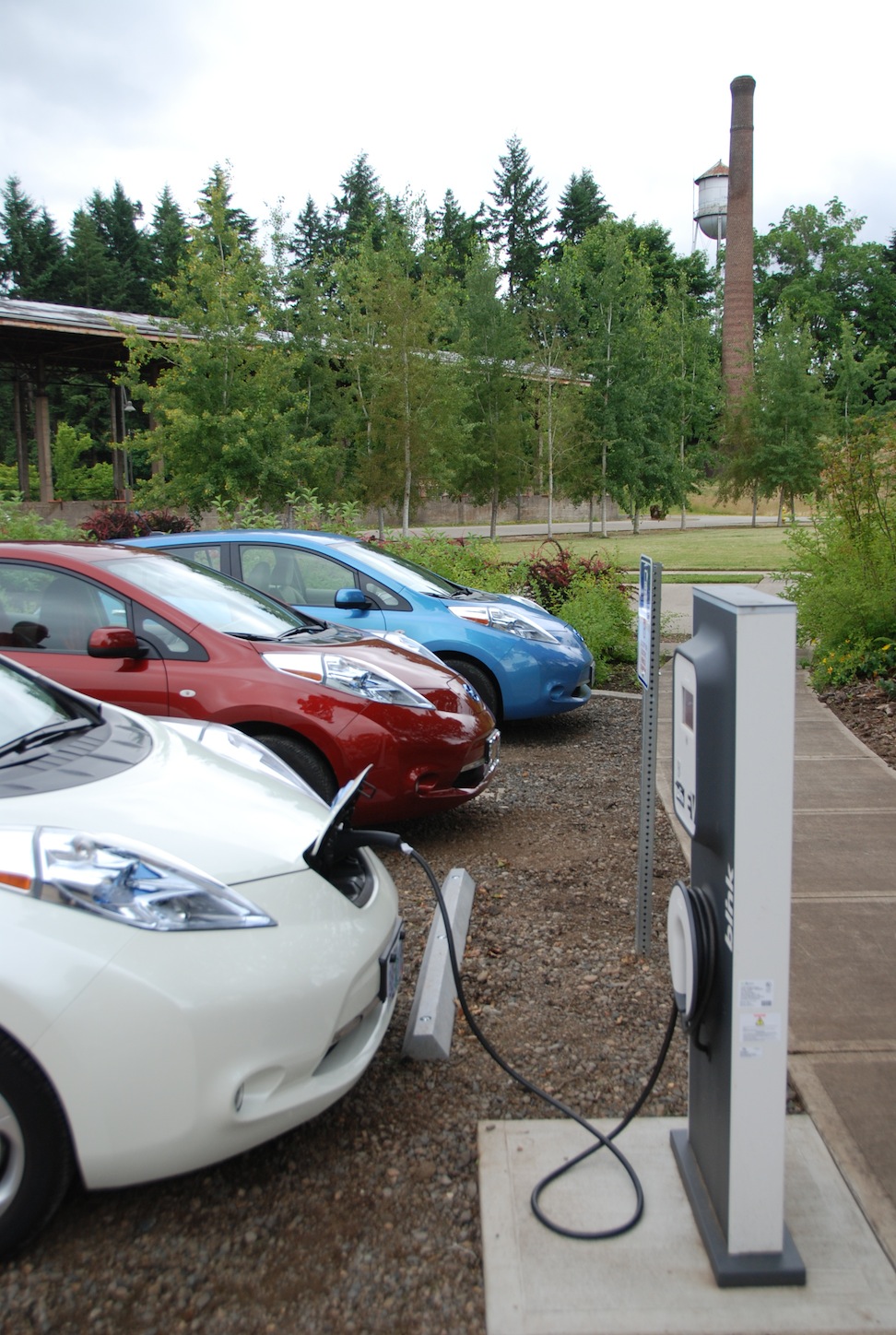
A line-up of Nissan Leafs at the event. There were also Chevy Volts and a Think City.

From left, Katie Gauthier (Senator Merkley's Office), Senator Merkley, James Meyer (Opsis Architecture), Don Myers (Pringle Creek Community), and Art James (ODOT).

6.27.2012

Community Open House! July 15th, 1-3pm

Pringle Creek Community invites you to an Open House on Sunday afternoon, July 15th, from 1-3 pm.

Come out and experience for yourself one of America's Top-Ten Green Communities. Walk through healthy and high-performance homes, visit with residents, and find out for yourself what makes living at Pringle Creek so special. There will be a self-guided walking tour along sidewalks and trails, tours of the gardens and glasshouses and Painters Hall, our LEED Platinum Net Zero Energy Community Center. 


You will have the chance to learn about LEED Platinum and Gold certified homes, ground-source geothermal heating and cooling, strategies for healthy indoor air, safe streets, rainwater harvesting, and what it's like to live in a community like this.


If you've ever considered living here, this is a great opportunity to meet our neighbors face to face and find out from their perspective what it's like to live in a healthy, high-performance home set in an incredibly well-designed community.

There will be refreshments in Painters Hall and staff available to answer any questions you might have about house packages, designs, or anything else that comes up Let us know if you have any questions, and we hope to see you there!
We love summer!! Friends and neighbors on the Painters Hall deck. Credit: Katie Brown Photography.

6.13.2012

Painters Hall Net Zero Energy data

For all you energy nerds out there, we now have two+ years of energy performance data from our real time energy monitors at Painters Hall (theenergydetective.com), so here's a little treat. Below is a graph that shows two comparative years of both consumption and production. From May 2010 to April 2011 (pink line) total building consumption was 15,291kWh. From May 2011 to April 2012 (the darker red line) total consumption was 19,838kWh. The big increase was the result of much more activity in the building (more events, Cafe use, etc.). The solar PV pretty much stayed the same; 2010-11 was 21,548kWh and 2011-12 was  22,234kWh.


However what looks like a pretty innocent increase in energy consumption has a pretty big impact on our 12-month net energy performance. Based on PGE net metering reports going back to October 2009 when the 20.2 kW system was installed, after our first 12 months of occupancy, we over-generated 11,000 kWh worth of energy, about double what the building consumed during the same period. All excess power was used (traded with PGE) and counted against the pumping of our ground-source geothermal loop, through a program called Aggregate Metering. As Painters Hall activity increased, so did energy consumption, reducing our excess net (as you can see below) taking it all the way down to where we are now, at about 3,000 kWh of excess net for the year. For example, we added the espresso machine in June 2010, but because this is a 12-month equation, the impact isn't immediately noticeable unless we compare Sept of 2010 with Sept of 2011 (11,000kWh and 4,000kWh)* note: the espresso machine, we have learned through energy monitoring, consumes about 5,293kWh per year!! whoa! We've since ordered a smaller replacement).


This graph shows how delicate the Net-Zero Energy balance really is. It is hard to size a PV system for NZE when there are so many variables and uses (office, Cafe, classroom, event venue, etc). For buildings that want to achieve NZE, a swing of of 8,000kWh is huge, in our case about 40% of total PV output for the year. The data also shows how much can change as occupancy and the building mature and develop over time.

6.04.2012

Steel Bridge Coffee

It is a little-known fact that coffee, like many other food products, goes bad over time when exposed to air; it is a surprisingly delicate product with great variation in quality and taste. Lucky for us, we have local coffee roaster Joseph Penner, who owns and operates Steel Bridge Coffee, delivering fresh, high quality coffees to Salem.
The difference between store-bought coffee and fresh-roasted coffee is like the difference between a grocery store strawberry picked two weeks too early and one plucked right out of the field and popped into your mouth. If coffee is something you enjoy, you really should try Steel Bridge for a week to experience what fresh roasted coffee is like. And, Joseph (who loves bicycling) delivers each week by bike, rain or shine, with a huge smile on his face! (photo at left while on delivery to Pringle Creek neighbors). Watch his awesome promo video below and sign up on his website... 


5.28.2012

Coho Cottage for Sale

This LEED Platinum 3 bedroom/2 bathroom 1,271 sqft Cottage with detached garage is now for sale for $329K. It's a beautiful home with stunning hardwood floors and natural light, located in a quiet corner of Pringle Creek Community. If you are interested in learning more, let us know, we are happy to show you around!


Greenroofs in full bloom

It's that time of year again when the greenroofs at Pringle Creek burst to life. This year we saw the new arrival of several camas lilies (which apparently take two years to mature and bloom). Bulbs such as these, and others (fawn lily, onion and other alliums) really thrive up here -- they can tolerate wet feet and a dry dormant summer. Below is the view outside our bedroom window! We've seen all sorts of birds and bumblebees, and it is way more interesting that looking out over a regular metal or flat roof, in addition to the fact that this roof type lasts longer (shielded from UV light) and provides a big environmental benefit (acts like a giant sponge) reducing impact on the watershed.


Yes, this is a rooftop garden.....

Walkable Communities & Property Value

Wondering what kinds of properties will hold value in the future?
From the New York Times:
http://www.nytimes.com/2012/05/27/opinion/sunday/now-coveted-a-walkable-convenient-place.html


May 25, 2012
Now Coveted: A Walkable, Convenient Place

By CHRISTOPHER B. LEINBERGER

WALKING isn’t just good for you. It has become an indicator of your socioeconomic status.

Until the 1990s, exclusive suburban homes that were accessible only by car cost more, per square foot, than other kinds of American housing. Now, however, these suburbs have become overbuilt, and housing values have fallen. Today, the most valuable real estate lies in walkable urban locations. Many of these now pricey places were slums just 30 years ago.

Mariela Alfonzo and I just released a Brookings Institution study that measures values of commercial and residential real estate in the Washington, D.C., metropolitan area, which includes the surrounding suburbs in Virginia and Maryland. Our research shows that real estate values increase as neighborhoods became more walkable, where everyday needs, including working, can